- The AI Report
- Posts
- ⚡ The hidden cost of AI progress
⚡ The hidden cost of AI progress
Major tech advances are reshaping how we build software, but someone has to pay the bill

The AI Report
July 29, 2025
In partnership with


This week's AI developments tell three crucial stories: the technical architecture race happening behind the scenes, Google's surprising resilience against ChatGPT disruption, and the hidden costs of AI progress landing on your electricity bill. Plus, the coding world is splitting between "vibe coding" and systematic context engineering.
Table of Contents
🏗️ The Big LLM Architecture Showdown
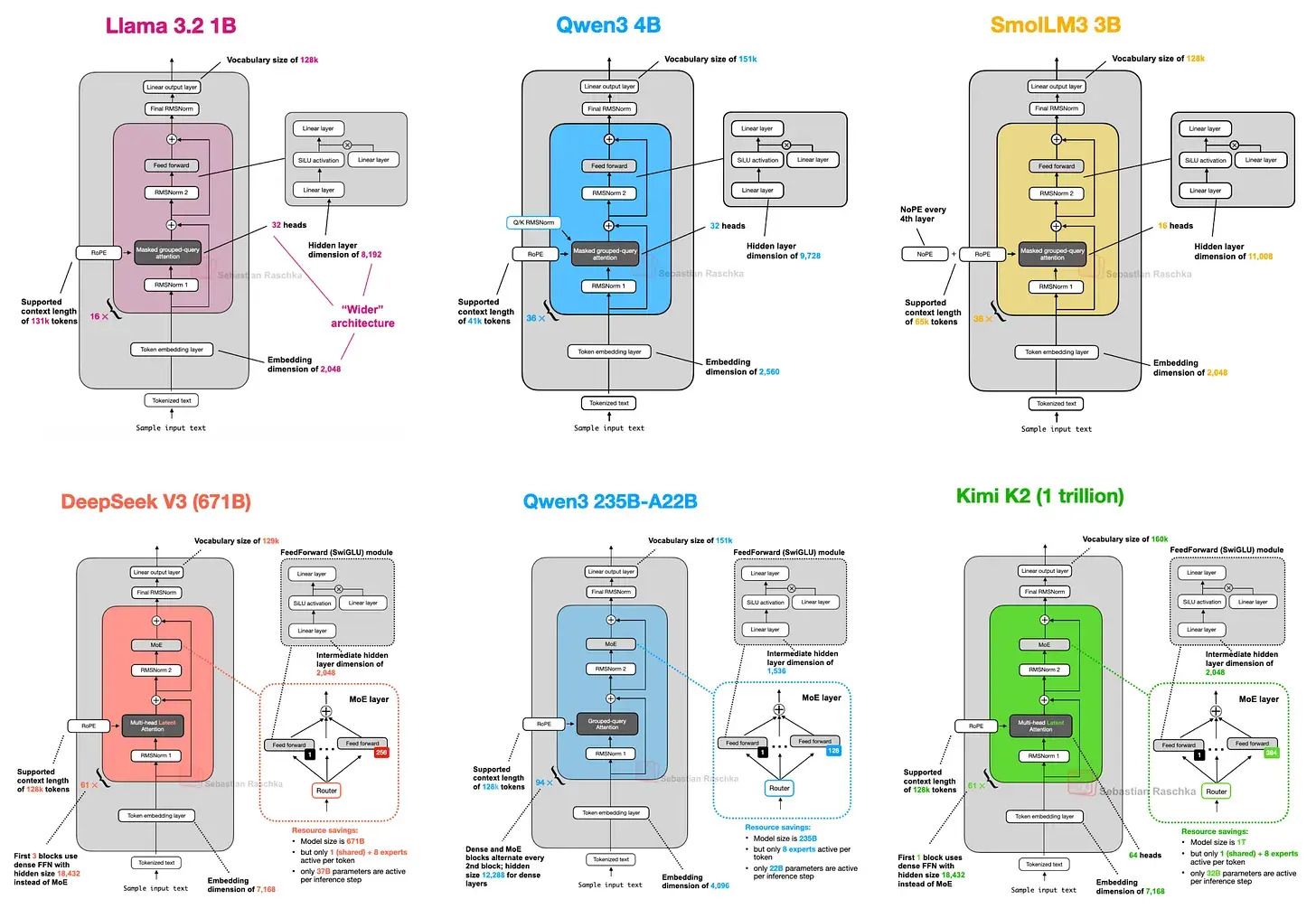
Credit: Sebastian Raschka
Sebastian Raschka drops the definitive guide to what's actually happening inside today's frontier models. Spoiler alert: despite all the hype, we're still polishing variations of the same 7-year-old GPT foundation.
DeepSeek V3's Multi-Head Latent Attention (MLA) compresses key-value tensors to slash memory usage while outperforming standard attention mechanisms
DeepSeek V3 (671B total, 37B active), Llama 4 (400B total, 17B active), and Qwen3 all embrace sparse Mixture-of-Experts architectures for efficiency
Gemma 3 uses 5:1 sliding window attention ratio while OLMo 2 adopts Post-Norm placement, and Mistral abandons sliding windows entirely for speed
Models experiment with QK-Norm, RMSNorm placement variations, and even No Positional Embeddings (NoPE) in SmolLM3
The 1 trillion parameter Kimi K2 model using DeepSeek architecture becomes the most impressive open-weight model, trained with the Muon optimizer
🤔 Why It Matters:
While the AI world fixates on benchmark battles, the real innovation is happening in architectural efficiency. These technical advances determine which models can actually run affordably in production, shaping who gets access to frontier AI capabilities.
Turn AI Into Your Income Stream

The AI economy is booming, and smart entrepreneurs are already profiting. Subscribe to Mindstream and get instant access to 200+ proven strategies to monetize AI tools like ChatGPT, Midjourney, and more. From content creation to automation services, discover actionable ways to build your AI-powered income. No coding required, just practical strategies that work.
📈 Google Reclaims Its AI Throne

Reports of Google's ChatGPT-induced demise were greatly exaggerated. The search giant just posted numbers that suggest AI is making it stronger, not weaker, while competitors scramble to catch up.
AI Overviews driving growth: Google's ChatGPT-like search features are generating 10% more queries globally, particularly among younger users who had been abandoning traditional search
Gemini momentum: Daily prompts increased 50% quarter-over-quarter, reaching 450 million monthly users (up from 350 million in March)
Processing power flex: Google handled nearly a quadrillion AI tokens last month—more than double what it processed in May, showcasing infrastructure dominance
Talent retention confidence: CEO Sundar Pichai dismisses competitor poaching concerns, with DeepMind's Demis Hassabis calling Meta "not at the frontier"
Strategic positioning: While GPT-5 looms and antitrust threats persist, Google's early AI integration appears to be strengthening rather than cannibalizing its core business
🤔 Why It Matters:
Google's resilience challenges the narrative that ChatGPT would destroy traditional search. Instead, the company is proving that incumbent advantages—distribution, infrastructure, and data—can trump first-mover status in the AI race.

🗞️ AI Bytes
📰 Trump Declares America Will "Win" AI Race Against China
President Trump announced plans to invest billions in AI infrastructure to compete with China, calling it a "race in the dark" with no clear finish line. Policy experts note the irony: both countries will have advanced AI regardless, making this more about mobilizing resources than achieving actual victory. The competition resembles past "races" like nuclear arms that cost fortunes but delivered unclear wins.
📰 Vogue Features First AI Model, Sparking Beauty Standards Debate
Guess's AI-generated model appeared in Vogue's August print edition, marking the first time an artificial person graced the magazine's pages. Critics worry about setting impossible beauty standards and displacing real models, especially those promoting diversity. The AI company admits users don't engage with diverse AI models, revealing uncomfortable truths about algorithmic bias in beauty.
📰 Developer Ships Like "Team of Five" Using Claude Code
A startup GM shares how Claude Code transformed him from programmer to engineering manager, running multiple AI developers simultaneously. He hasn't typed a function in weeks yet ships faster than ever, describing it as the first tool that makes coding genuinely optional. The shift from implementation to delegation represents a fundamental change in how software gets built.
📰 The Death of "Vibe Coding" and Rise of Context Engineering
The era of casual AI prompting is ending as developers embrace systematic "context engineering"—treating AI context like engineered infrastructure. While vibe coding feels productive for prototypes, it creates technical debt at scale. Professional development now requires structured approaches that provide AI with comprehensive documentation, rules, and validation frameworks for reliable results.
🛠️ Top AI Tools This Week
🤖 Kiro
Kiro maps your specs, generates documentation, and adapts to your whole stack. It's like onboarding a junior dev who reads all your design docs. Prompt Kiro to define and scope features with clear requirements before any code is written, build end-to-end functionality with tests and documentation that make handoff easier, and use agents to solve tricky coding challenges or extend features across your codebase.
On a scale of 1 to AI-takeover, how did we do today? |