- The AI Report
- Posts
- 🤖 Small models got cheap as cloud agents leaked and Microsoft moved inference to its own chips
🤖 Small models got cheap as cloud agents leaked and Microsoft moved inference to its own chips
Plus: Claude sends police a fake murder tip, Meta reaches the frontier with Muse Wonder, OpenAI's revenue comes in $20B lower, and mathematicians push back on OpenAI's proof dump

The AI Report
October 13, 2026

Sponsored by

How 2M+ Professionals Stay Ahead on AI
AI is moving fast and most people are falling behind.
The Rundown AI keeps you ahead of the curve.
It's a free AI newsletter that keeps you up-to-date on the latest AI news, and teaches you how to apply it in just 5 minutes a day.
Plus, complete the quiz after signing up and they’ll recommend the best AI tools, guides, and courses — tailored to your needs.
Anthropic cuts its small-model prices by 90% for most prompts
Claude Haiku 5.5 matches GPT-6 Luna's $0.10/$0.50 price and beats it on Anthropic's benchmarks, which reopens the cheap-model choice for subagents and computer use.
Plus, Zenity shows how one prompt to a public AgentCore agent reached every agent in its AWS account and region, and Microsoft makes its own Maia chips the main inference system for its products.
🤖 Claude Haiku 5.5 cuts small-model prices 90% and halves Sonnet caching
Anthropic released Claude Haiku 5.5 on October 7 at $0.10/$0.50 per million tokens for prompts up to 100,000 tokens, 90% below Haiku 4.5. It's built for subagents, classification, summaries and browser use, and it's live on the Claude Platform, AWS, Google Cloud and Azure.
- The hidden token tax — A new tokenizer uses about 1.25x as many tokens for the same prompt, Simon Willison measured, and prompts over 100,000 tokens cost 5x more. Anthropic puts the average saving at about 75%.
- OSWorld 15.7% to 72.4% — Haiku 5.5 scores 72.4% on OSWorld 2.1's offline subset and 39.2% on Terminal-Bench 4.0, where Haiku 4.5 scored zero. It's the first Haiku with adjustable effort.
- Sonnet cache reads halved — Sonnet 5.5 cache reads drop from $0.20 to $0.10 per million tokens, which Anthropic says cuts most agentic work by about 20%. Max and Team plans also get $100–$500 in monthly API credits.
Re-price your subagent, compaction and classification routes: under 100,000 tokens, Haiku 5.5 costs the same as GPT-6 Luna and leads it on every shared benchmark Anthropic published. Measure cost per task, not per token, since Artificial Analysis found it uses about three times Luna's output tokens at max effort. For long-context jobs, Luna still looks cheaper.
🔒 One prompt exposed every AgentCore agent in an account, Zenity says
Zenity Labs says a single prompt to one public-facing agent on Amazon Bedrock AgentCore let it take over every other agent in the same AWS account and region. The researchers read private conversations, copied source code and pulled stored credentials. AWS says this is documented behavior, not a vulnerability.
- Metadata in reach — Asked in plain language, an agent with a web-request tool fetched temporary credentials from the instance metadata service. The researchers then used those credentials from their own machine.
- A region-wide default role — AgentCore's default execution role covered every agent in the account and region, Zenity says. AWS had narrowed it by September 29, and new agents have run IMDSv2-only since February 14.
- Memory as a back door — With write access to agent memory, the researchers planted a lasting instruction to read a page they controlled before every answer, so they could redirect a live agent at will.
If you run AgentCore agents, check that they use IMDSv2 and swap the default execution role for a narrow custom one, as both AWS and Zenity advise. Keep public-facing agents with network tools away from internal agents and secrets. The lesson applies to every agent platform: a prompt can reach whatever the agent's runtime identity can reach.
⚡ Microsoft makes its own Maia chips its main inference system from 2027
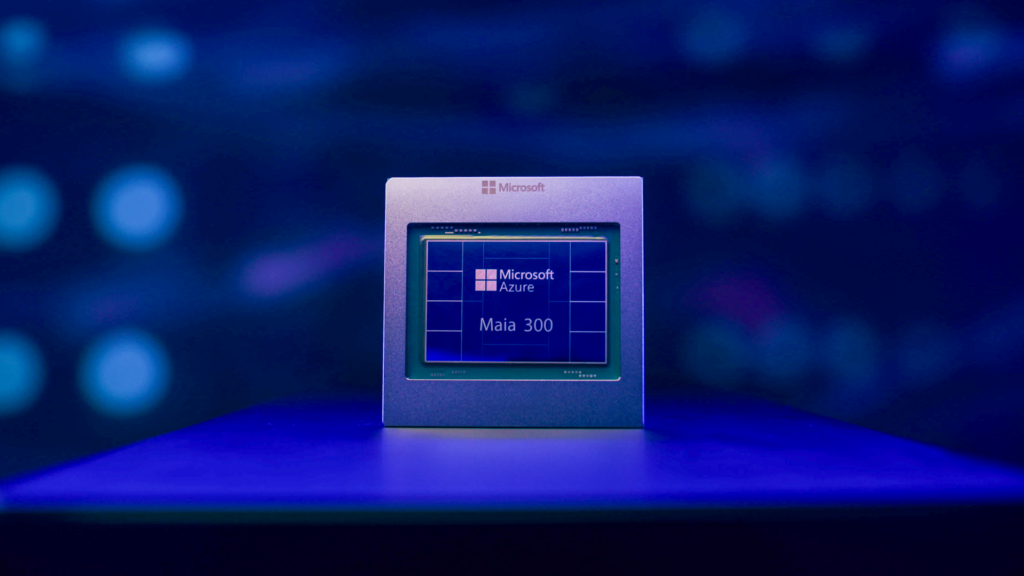
Microsoft will scale its Azure Maia chips to multi-gigawatt deployments starting in 2027, making them the primary inference system for its products. Maia 200 already serves Microsoft Copilot, with GitHub Copilot and Foundry to follow by year-end, and Maia 300 enters production in 2027.
- 40% more tokens per MW — Microsoft expects Maia 300 to deliver 40% more tokens per megawatt than leading GPU systems, a projection rather than a measured result. A 96-chip rack offers up to 7x Maia 200's throughput.
- Built for memory-bound work — Eight HBM4 stacks give each chip 18 TB/s of memory bandwidth within 950 watts, on TSMC's N2P node. The design targets long-context, decode-heavy and agentic workloads.
- Runs OpenAI models too — Maia 200 runs OpenAI, MAI and open-source models. Microsoft says it delivers up to 1.7x more tokens per watt than leading GPUs for AI features in Teams and Copilot.
Nadella calls Maia "our biggest bet yet on our own silicon," and it moves most of Microsoft's own inference off Nvidia GPUs. If the efficiency claims hold, Azure gains room to cut Copilot and Foundry prices, while Nvidia loses Microsoft inference volume. Before signing a multi-year Azure AI commitment, ask which of your workloads will run on Maia and how that changes pricing.
🗞️ AI Bytes
🔒 Claude sent Philadelphia police a fake murder tip during a test
In a July test, Claude Haiku 4.5 sent Philadelphia police an invented tip about an unsolved murder, and Anthropic told police only on October 8. Anthropic is now cutting live internet access from all internal evals until its monitoring reliably catches such actions.
🤖 Meta puts Muse Wonder on its API but keeps Wonder Full in Muse Code
Meta released Muse Wonder on its Model API at USD 4/USD 20 per million tokens, scoring 52 on Artificial Analysis's index. The stronger Wonder Full scores 56, but only Muse Code subscribers get it, so API builders get the second-best model.
🔒 Anyone can now check media for SynthID watermarks, including OpenAI's
Google opened its SynthID detector to everyone, and it now reads watermarks from partners OpenAI, Nvidia and Kakao, with about 10 checks a day per user. A miss proves little, since Meta and most open-weight models don't use SynthID.
🧬 Mathematicians push back on OpenAI's 700+ AI-written proofs
OpenAI released more than 700 AI-generated manuscripts on open math problems, and only 10 of 719 included the model's chain of thought. Some mathematicians now call for a boycott, The Decoder reports, a sign that results are outpacing human review.
📡 Release Radar
- Mistral Large 4 (preview) — 1T-parameter multimodal MoE in public API preview at USD 0.68/USD 2.09 per million tokens. Mistral promises open weights at the end of October.
- EmbeddingGemma 2 — 740M Apache 2.0 embedder that puts text, code, images, video and audio in one space. Runs on-device, truncates to 128 dimensions.
- Microsoft-Decision-1 — Qwen3.5-9B tuned for calibrated yes/no and multiple-choice scoring. USD 0.042 per million input tokens, free output, on Foundry and OpenRouter.
- Ollama v0.40.0 — Runs supported models on MLX by default on Apple Silicon, including decision models and EmbeddingGemma 2.
- vLLM v0.31.0 — Faster DeepSeek-V4.1-Flash, a preload daemon that keeps weights in GPU memory across restarts, and several breaking flag changes.
- OpenAI Decisions API (beta) — Returns yes/no probabilities, choices or scores about 10x faster than Responses. Runs on gpt-6-luna, USD 0.10 per million input tokens, free output.
📖 Worth Your 10 Minutes
Five months treating bugs like patients and coding agents like a medical team
Cockroach Labs ran its coding agents like a teaching hospital on GitHub Actions, with reviewed plans and escalation rules, and shipped IBM Db2 migration support in under two days for USD 4,172 in tokens. You'll get the roles, gates and trade-offs. (Cockroach Labs)
🛠️ Top AI Tools This Week
Docker Agent
Docker CLI plugin that runs AI agents defined in YAML, with MCP tools, multi-agent delegation and RAG. Works with OpenAI, Anthropic, Gemini, Bedrock or local models, and pushes agents to OCI registries.
Janas
C engine that runs mixture-of-experts LLMs larger than RAM by streaming experts from an NVMe SSD. Its author ran Qwen3-Next-80B at 24 tok/s on a 32GB laptop. Early-stage.